
Overview
Vilnius is the capital and largest city of Lithuania (population about 600,000), in the country's southeastern corner about 30 kilometers from the Belarus border. The city sits at the confluence of the Vilnia and Neris rivers in a glacially-carved valley surrounded by forested hills, and the layered history reads as a who's-who of central-European powers: founded in 1323 by Grand Duke Gediminas of the Grand Duchy of Lithuania (which became, through dynastic union with Poland, the Polish-Lithuanian Commonwealth, at its 16th-century peak the largest country in Europe, stretching from the Baltic to the Black Sea); incorporated into the Russian Empire after the 1795 partition; briefly independent 1918-1940; absorbed into the Soviet Union 1940-1990; finally re-independent since 1990 as the capital of the newly free Lithuanian Republic. Each era left meaningful architectural and cultural layers. UNESCO inscribed the historic center as a World Heritage Site in 1994, recognizing it as one of the largest surviving medieval-and-Baroque old towns in northern Europe (about 360 hectares — significantly larger than the historic centers of Prague, Kraków, or Vienna).
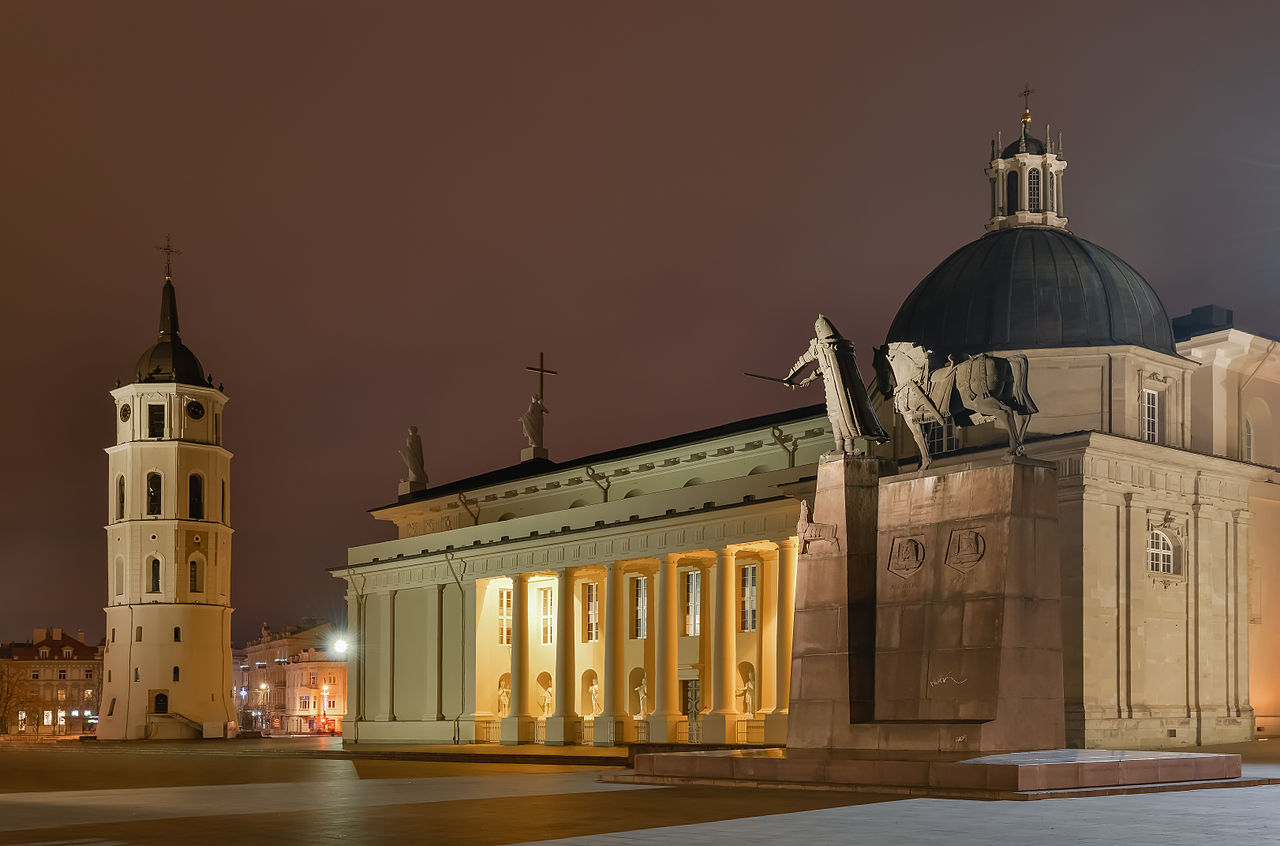
The defining visual feature of Vilnius is the architectural mix of the historic old town: about 1,500 surviving buildings spanning Gothic, Renaissance, Baroque, Classical, and 19th-century styles, with the Baroque period (when the city was the second-most important capital of the Polish-Lithuanian Commonwealth) particularly well preserved. The St. Anne's Church (a 16th-century Gothic-Renaissance brick fantasy that Napoleon famously said he wished he could put in his hand and bring home to Paris), the Cathedral of Vilnius (the white-marble Neoclassical cathedral on the central square with the iconic bell tower), the Gates of Dawn (the surviving city gate with the famous Black Madonna of Vilnius icon, one of Central Europe's most-venerated religious objects), and the Vilnius University complex (the oldest university in northern Europe, founded 1579, with the famous Sarbievius and the painted ceilings of the Smuglevičius Hall) are the architectural highlights. The dramatic 48-meter Gediminas' Tower (the surviving remnant of the original 14th-century Upper Castle, on the hilltop in the center of the old town) is the canonical Vilnius landscape feature.
Vilnius's modern travel-quality is shaped by two distinct contemporary features. First, the famous Užupis district, a small artists' neighborhood across the Vilnia River from the historic old town that declared itself the 'Republic of Užupis' on April 1, 1997, with its own constitution (41 absurdist and poetic articles, with the famous lines 'Everyone has the right to make mistakes' and 'A dog has the right to be a dog'), president, currency, and ambassador to other countries, including the actual diplomatic position of 'Ambassador of Užupis to Outer Space.' The neighborhood is genuinely a working artist colony with hundreds of artists' studios, small galleries, the famous bronze 'Angel of Užupis' statue in the central square, and the iconic constitution wall (in 30+ languages). Second, the food scene — Vilnius has emerged in the 2010s-2020s as one of Europe's most exciting affordable food cities, with the Lithuanian-cuisine revival movement (Senatorių Pasažas, Nineteen18, Stebuklai, Šturmų Švyturys) creating world-class restaurant experiences at central-European prices. Beyond the immediate Vilnius area, the country's major attractions include Trakai Island Castle (28 km west, the famous 14th-century red-brick castle on an island in Lake Galvė), the Hill of Crosses near Šiauliai (Lithuania's most distinctive religious site, with hundreds of thousands of crosses left by pilgrims), and the Curonian Spit (UNESCO World Heritage sand-dune peninsula on the Baltic). Most international visitors stay 2-4 nights in Vilnius.
Best Time to Visit
May to September — warm enough for walking
Vilnius has a humid continental climate with four distinct seasons. The genuine sweet spots are May-June and September, daytime highs of 65-78F, lower humidity, and reliable conditions for the extensive walking the old town requires. Summer (July-August) is the busiest tourist period, daytime highs of 75-85F, all attractions open, and the famous Vilnius midnight sun (the sun sets after 10pm in June). Winter (November-March) is cold (20-35F daytime) with frequent snow — atmospheric for Christmas markets and the famous Užgavėnės pre-Lenten masked festival, but limits the open-air walking. The annual Kaziuko Mugė craft fair (early March) is Lithuania's largest cultural event.
Top Attractions
Vilnius Old Town Walking Tour
Free; guided tour $15-$30The UNESCO-listed historic center — Europe's largest surviving Baroque old town at about 360 hectares. Walk Pilies Street (the main pedestrian street) from Cathedral Square to the Gates of Dawn, passing the University, the Presidential Palace, and dozens of churches and monasteries. 3-4 hour self-guided walk; guided tours $15-$30 per person.
Gediminas' Tower & Castle Hill
Tower: $4-$6; funicular $1.50The surviving 14th-century brick tower on the hilltop in central Vilnius — climb either via the funicular ($1.50) or the steep walking path (15 minutes) for panoramic views over the entire old town. The small museum inside the tower shows the original 14th-century Vilnius layout. The most-photographed Vilnius viewpoint, especially at sunset.
Užupis Republic Walking Tour
FreeThe self-declared artists' republic across the Vilnia River — visit the central Užupis Square with the bronze 'Angel of Užupis' statue, the famous constitution wall (in 30+ languages), the Tibetan Square (the only memorial to the Tibetan struggle outside of Tibet itself), and the dozens of small art galleries, studios, and artist cafés. 60-90 minute walk; the small neighborhood is genuinely compact.
Vilnius University Complex
Self-guided free; Smuglevičius Hall tour $5-$10The oldest university in northern Europe (founded 1579), 13 interconnecting courtyards, the famous Smuglevičius Hall with painted ceilings (open via guided tour), the St. John's Church inside the complex, and the Astronomical Observatory (with the original 18th-century telescope). The university is still actively operating; most courtyards are accessible during business hours.
Trakai Island Castle Day Trip
Castle entry: $8-$12; round trip $5-$10The famous 14th-century red-brick castle on an island in Lake Galvė, 28 km west of Vilnius (40 minutes by train or bus). The most-photographed Lithuanian landmark; rowboat rentals on the lake ($5-$15) give the best photographic angles. Combine with traditional Karaim (Crimean Tatar) cuisine at the village restaurants (the historic Karaim community has lived in Trakai since the 1390s).
Hill of Crosses (Šiauliai) Day Trip
Free entry; rental car ~$60-$100 for the dayLithuania's most distinctive religious site, 215 km northwest of Vilnius (2.5 hours by car or train) — hundreds of thousands of crosses left by pilgrims since the 1830s, with the practice becoming a quiet form of resistance during the Soviet period (when authorities repeatedly bulldozed the hill, only to find it covered with new crosses within weeks). Combine with the surrounding Šiauliai region for a long day trip.

Local Food
Cepelinai (Lithuanian Potato Dumplings)
$8-$15 per portionLithuania's national dish — large oval potato dumplings (named 'zeppelins' for their shape) filled with meat (or sometimes cheese or mushrooms), boiled and served with sour cream and bacon-onion sauce. Senatorių Pasažas, Etno Dvaras, and the traditional Lithuanian restaurants serve excellent versions. Eat 2-3 per person for a hearty meal.
Šaltibarščiai (Cold Beetroot Soup)
$4-$10 per bowlLithuania's summer signature — bright-magenta cold soup of beetroot, kefir, cucumber, dill, and hard-boiled egg, served with hot boiled potatoes on the side. The visual is striking; the flavor is refreshing on hot summer days. All traditional Lithuanian restaurants serve it from late spring through early autumn.
Kibinai (Karaim Pastry)
$3-$8 per pastryA Trakai-region specialty from the Karaim (Crimean Tatar) community who settled in Lithuania in the 1390s, small handheld baked pastries filled with mutton, beef, or chicken. Available at Karaim restaurants in Trakai (Kybynlar, Senoji Kibininė) and at some Vilnius restaurants. The standard travel-snack version of Lithuanian cuisine.
Vilnius Craft Beer
Pint $4-$8Lithuania's craft beer scene has exploded since 2015, small breweries like Sakiškių Alus, Genys Brewery, Dundulis, and the famous Vilniaus Alus produce excellent traditional Baltic-style lagers and modern IPAs. Beer bars like Bukowski, Šnekutis, and the brewery taprooms are central to Vilnius evening social life. The price-to-quality ratio is genuinely excellent.
Lithuanian Wine & Krupnikas (Honey Liqueur)
Bottle: $15-$45Krupnikas is Lithuania's traditional spiced honey liqueur — vodka or rye spirit infused with 25+ spices and herbs (cinnamon, cloves, vanilla, cardamom, saffron), sweetened with honey, served as a digestif. Made by Stumbras and several smaller producers; sold in distinctive ceramic bottles as the canonical Lithuanian souvenir.
Budget Guide
Budget
$40-$100/day
Hostels and budget hotels in central Vilnius ($20-$60/night) — Hostelgate, Mikalo House, Down Town Forest. Local meals at small Lithuanian restaurants and cafes ($6-$15 per meal). Walk the old town and Užupis (free), Gediminas' Tower ($4-$6), public bus to Trakai ($5-$10 round trip). Lithuania is one of Europe's cheapest capitals.
Mid-Range
$80-$200/day
Boutique hotels in central Vilnius ($50-$150/night), Hotel Pacai (a converted 17th-century Baroque palace), Stikliai Hotel, Conti Hotel. Restaurant dinner at Nineteen18, Senatorių Pasažas, or Stebuklai ($25-$60 per person with wine). Private guided old town walking tour with historian, full-day Trakai + Karaim cuisine excursion, Vilnius University Smuglevičius Hall tour.
Luxury
$200-$500+/day
Kempinski Hotel Cathedral Square Vilnius ($250-$500/night), Hotel Pacai (the 17th-century Baroque palace conversion, $180-$400), Stikliai Hotel ($200-$450). Private guide for the old town with an art historian, private dinner at a noble's restored palace, Vilnius Museum of Illusions or art-collection private viewing, helicopter tour over the surrounding lakes, private Trakai Castle visit with rowboat lunch.
Travel Tips
Fly into Vilnius Airport (VNO) — Lithuania's main international airport, 7 km south of central Vilnius. Direct flights from London, Frankfurt, Vienna, Warsaw, Tallinn, Riga, Helsinki, Oslo, Copenhagen, and seasonal flights from elsewhere on Air Baltic, Lufthansa, Ryanair, Wizz Air, LOT Polish Airlines, and others. From the airport to central Vilnius: city bus #88 ($1.50, 30 minutes), train (15 minutes, $1), taxi ($10-$20).
Vilnius is genuinely affordable for a European capital. Hotel rates, restaurant meals, taxis, and tour costs are significantly lower than equivalents in Prague, Budapest, or Kraków — Vilnius is consistently rated as one of Europe's best value-for-money capitals. The combination of UNESCO old-town quality + Baltic-budget prices is the genuine travel proposition.
Bring layers — Baltic weather is unpredictable. Even summer Vilnius can swing 15-20°F day-to-day; brief rain showers are common any season. Pack a waterproof jacket, comfortable walking shoes (the old town cobblestones are uneven), and a warm sweater for evenings. Winter requires serious cold-weather gear; the Vilnius Christmas Market (December) is beautiful but cold (15-30F daytime).
Try the Lithuanian sauna culture. The Baltic sauna tradition (similar to but distinct from Finnish sauna) is central to the culture; Vilnius has multiple high-quality sauna experiences (Bistras Spa, Naturalia Spa, the Stikliai Hotel spa). The traditional pirtis (Lithuanian black sauna) is genuinely different from the Finnish löyly experience — worth trying for the cultural depth.
Lithuanian euro (EUR) is the currency since 2015. ATMs (SEB, Swedbank, Luminor) are common throughout central Vilnius; cards are widely accepted at all restaurants, hotels, and shops. Bring small Euros for the public bus tickets, market vendors, and tips. Tipping is 10% standard at restaurants.
Combine with Riga and Tallinn for the standard Baltic capitals route. The classic itinerary: 2-3 nights Vilnius + 2-3 nights Riga, Latvia (4 hours by bus or train from Vilnius) + 2-3 nights Tallinn, Estonia (4.5 hours by bus from Riga). All three capitals have meaningful historical depth + cultural distinctiveness + affordable prices. The Lux Express buses run multiple times daily between the three; train service is limited.
Vibes
Ready to visit Vilnius?
Let our AI plan a personalized itinerary with flights, hotels, and activities.
Going with friends? Plan Vilnius together in a group room, where everyone votes on dates and budget and books their own way.
Related reads

Photo by Clay Banks on Unsplash
Destination Guide
A First-Timer's Guide to Tokyo

Photo by Aayush Gupta on Unsplash
Destination Guide
48 Hours in Lisbon: The Perfect Weekend

Photo by Charlotte Noelle on Unsplash
Destination Guide
Hidden Gems of the Amalfi Coast

Photo by KUSHAGRA DHALL on Unsplash
Destination Guide
7 Best Street Food Cities in the World

Photo by Logan Armstrong on Unsplash
Destination Guide
48 Hours in Barcelona: Sun, Tapas, and Gaudi

Bulgaria
Plovdiv Travel Guide

Bosnia and Herzegovina
Sarajevo Travel Guide
Romania
Brașov Travel Guide

Georgia
Tbilisi Travel Guide

Czech Republic
Český Krumlov Travel Guide

Mexico
Puebla Travel Guide

Photo on Unsplash
Travel Hack